Sewing for Homeschoolers
Give students the opportunity to learn a practical skill while applying math, problem solving, creativity, design and independent thinking.
EveryoneCanSew offers approachable, project-based sewing programs for homeschool students, families, co-ops, hybrid programs and learning communities throughout the DFW area.
Beginners welcome • Programs available for kids & teens
Sewing gives students a reason to use academic skills in the real world.
They aren't measuring because a worksheet tells them to.
They're measuring because they want their project to fit.
They aren't solving an imaginary problem.
They're figuring out why something didn't work—and how to fix it.
And when they're finished, they have something tangible they can proudly say:
“I MADE THIS.”
More Than Just Sewing
Measurement • Fractions • Geometry • Proportion • Estimation
Students use rulers and measuring tools, work with fractional measurements, calculate seam allowances, determine project dimensions and see how accurate math affects the finished result.
Color • Texture • Pattern • Proportion • Personal Expression
Students make choices about fabrics, colors and design while discovering how individual pieces come together to create a finished project.
Plan • Make • Test • Troubleshoot • Improve
Sewing teaches students that mistakes aren't necessarily the end of a project. Students learn to identify problems, consider solutions, make adjustments and keep going.
Machine Operation • Tool Safety • Construction • Alteration • Repair
Students develop practical abilities they can use throughout their lives while becoming increasingly comfortable working independently with tools and equipment.
Supporting Texas TEKS Through Hands-on Learning
EveryoneCanSew's project-based curriculum can support and reinforce concepts found within the Texas Essential Knowledge and Skills (TEKS) in areas including mathematics, fine arts and design, technology and problem solving, and career and technical skills.
Academic connections vary by student age and by project.
GRADES 3–5
Emphasis on measurement, fractions, geometry, following directions, creative expression and introductory problem solving.
GRADES 6–8
Students begin applying proportional reasoning, more complex measurement, design concepts, fiber arts, technical skills and a structured design-and-problem-solving process.
GRADES 9–12
Programs can introduce increasingly advanced textile, construction and design concepts, including skills that connect with Texas Career & Technical Education areas such as Fashion Design.
EveryoneCanSew programs support and reinforce selected TEKS concepts. Individual workshops and enrichment programs are not represented as complete instruction in a TEKS subject or as automatically satisfying Texas public-school course-credit requirements.
Whether you're looking for a one-time enrichment experience or a progressive semester elective, we can explore a program that works for your students.
A fun first experience with sewing.
This one-time, hands-on workshop introduces students to safe sewing-machine operation, basic sewing terminology and fundamental sewing skills while they complete an approachable beginner project.
Students get the excitement of using a sewing machine and taking home something they made themselves.
Great for:
Homeschool enrichment days • Special events • Life-skills programs • Clubs • Groups wanting to try sewing before committing to a longer program
Typical format: Approximately 2 hours
Learn. Build. Complete.
Students build their skills progressively through carefully selected projects.
Each class reinforces previously learned techniques while introducing something new. Depending on age and experience, students may explore sewing-machine operation, seams, pressing, measuring, fabric basics, simple construction and useful projects.
Rather than trying to learn everything at once, students gain confidence one skill—and one finished project—at a time.
Great for:
Homeschool co-ops • Enrichment programs • Clubs • Small groups • Short-term electives
Typical format: 4–6 classes
Build skills that last a lifetime.
A semester program gives students time to move beyond simply learning how to operate a sewing machine.
Students progressively develop their skills through project-based instruction while practicing measurement, planning, problem solving, tool safety, construction techniques and independent project completion.
Depending on age and experience, students can explore areas such as:
Beginner Sewing
Learn your machine, sewing terminology, fabric basics, seams, pressing, measuring and foundational construction skills.
Bags & Useful Projects
Explore handles, pockets, linings, zippers, interfacing, hardware and increasingly dimensional construction.
DIY • Alter • Repair
Develop practical skills for hemming, repairing, altering and creating useful things for home and wardrobe.
Garment Sewing
Explore patterns, measurements, grainline, fabric selection, darts, gathering, sleeves, closures, fitting and garment construction.
Great for:
Homeschool co-ops • Hybrid programs • Learning communities • Homeschool enrichment programs
Typical format: Approximately 12–14 classes
Beginners Are Welcome!
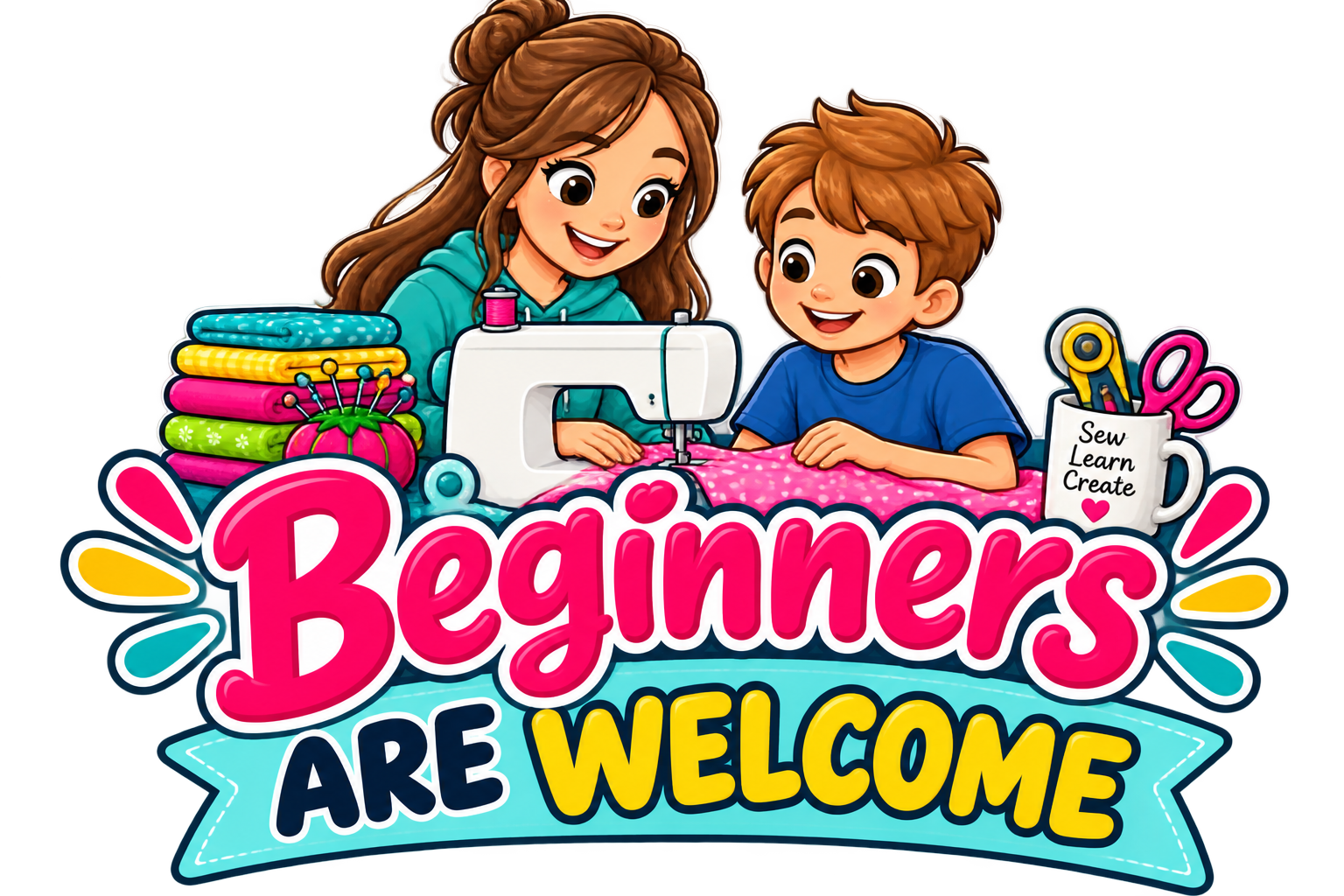
No previous sewing experience is necessary.
Students don't need to arrive already knowing how to sew.
That's what we're here to teach.
Programs can be adapted to the ages, experience levels, schedule and educational goals of your homeschool community.
We begin with foundational skills and build from there, giving students opportunities to become more capable and independent as their skills grow.
Safety Comes First
Sewing involves real tools—and learning to use them responsibly is part of learning to sew.
Students receive age-appropriate safety instruction before using sewing machines, scissors, pins, needles, irons, rotary cutters or other sewing equipment.
Tool privileges are introduced progressively based on the student's age, activity and demonstrated ability to use equipment safely.
Students learn simple habits such as:
Stop when something isn't right.
Keep hands away from blades, needles and heat.
Use tools only after learning how to use them safely.
Keep the workspace clean and organized.
Never distract someone operating equipment.
Ask for help when you need it.
Our goal isn't simply to tell students to “be careful.”
We want them to understand how to work safely and responsibly.
Learn By Doing
We believe students learn sewing best when they're making something they actually want to finish.
A project might begin with:
How big should it be?
That leads to measuring.
How much fabric do I need?
Now we're using math.
Why doesn't this piece fit?
Now we're problem solving.
What happens if I change this?
Now we're designing.
Can I fix my mistake?
Now we're troubleshooting.
And eventually:
“Look what I made!”
That experience builds more than sewing ability.
It builds confidence.
Are You a Homeschool Co-op or Learning Community?
EveryoneCanSew can work with homeschool co-ops, hybrid programs, learning communities and other homeschool organizations to develop sewing opportunities for their students.
Depending on your needs, we can explore:
One-time introductory workshops
4–6 week project-based series
Semester sewing & life-skills electives
Programs can be customized according to student ages, experience levels, schedule, class size and educational goals.
Curriculum, project planning, safety instruction and basic project materials can be incorporated into the program, with sewing machines and classroom equipment available depending on program needs.
Tell us about your homeschool community.
Are You a Homeschool Parent?
Looking for a sewing opportunity for your child?
Let us know you're interested.
As EveryoneCanSew develops homeschool workshops, small-group programs and classes in the DFW area, we'd love to know where families are looking for opportunities.
Tell us your child's age, where you're located and what type of sewing experience interests you.
Your interest can help us determine where to offer programs next.
Taught by People Who Love to Teach
We created EveryoneCanSew because we believe sewing is more than a hobby.
It's creativity.
It's problem solving.
It's independence.
It's a practical skill students can use throughout their lives.
And most importantly,